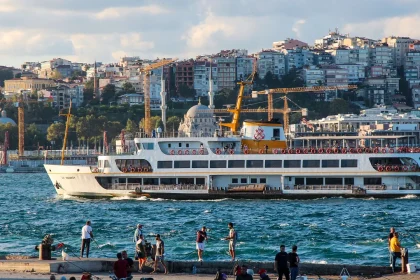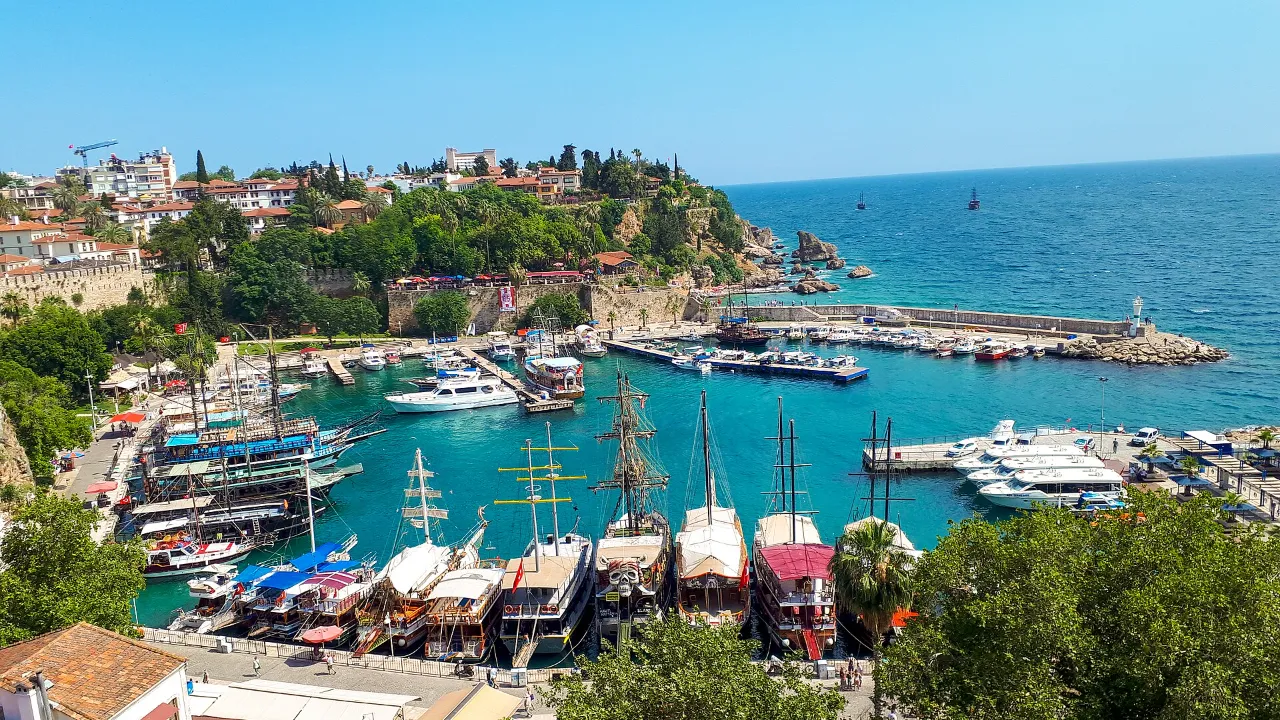

Antalya is the largest city on Türkiye’s Mediterranean coast. It is the country’s busiest holiday gateway, and it has one of the biggest foreign-resident communities in the country. Unlike the smaller resorts, it works as a full city all year round, with large hospitals, a university, tram lines and an airport with flights almost everywhere. This guide covers how the main districts differ, what homes cost and rent for in 2026, the rules foreign buyers need to know, and practical points about daily life.
Key points
- Antalya province had 2,777,677 registered residents at the end of 2025, including about 120,000 foreign nationals, according to TÜİK figures reported in February 2026.
- Antalya Airport handled more than 30.1 million passengers in the first nine months of 2026, according to DHMİ data, with flights to Europe all year.
- Endeksa put the province’s average price at about 55,300 lira per square metre in June 2026. Konyaaltı was close to 84,500 lira in September, and Kepez about 45,300 lira.
- Antalya was the second-biggest market for foreign buyers after Istanbul in August 2026, with 599 homes sold to foreigners. Russians were the largest group of buyers.
- Summers are long and hot. Winters are mild but wetter than most visitors expect.
Antalya at a glance
The metropolitan city is made up of five central districts: Muratpaşa, Konyaaltı, Kepez, Aksu and Döşemealtı. Together they form a continuous urban area of well over a million people between the Taurus Mountains and the sea. The wider province takes in resort districts such as Kemer to the south-west, Serik (with Belek) and Manavgat (with Side) to the east, Alanya further east, and Kaş (with Kalkan) to the west.
Tourism dominates the economy. The province welcomed 12.48 million foreign visitors in the first nine months of 2026, led by Russia, Germany and Poland. Our report on Antalya’s foreign visitor numbers has the breakdown. Agriculture, especially greenhouse farming, construction and services also matter. The city will be in the global spotlight in November 2026, when it hosts the UN climate summit, COP31, at the Antalya Expo Center from 9 to 20 November.
Because of its size, Antalya suits a wider range of people than the smaller resorts. Retirees, remote workers, families with school-age children and investors all buy there. People who want a quiet village life may prefer the outer districts or a resort such as Kaş. For a side-by-side view of the coast, see our guide to where to buy property in Turkey.
Getting there and getting around
Antalya Airport lies about 13 km north-east of the city centre and has two international terminals and a domestic terminal. It handled about 39 million passengers in 2025. Between January and September 2026 it served 30,144,861 passengers, according to DHMİ data reported by Anadolu Agency, and in September alone more than 4.3 million of its 5 million passengers were international. Read more in our report on Antalya Airport passing 30 million passengers. Flights are busiest from April to October, but unlike Dalaman or Bodrum, Antalya keeps a solid network of direct routes to Europe and frequent domestic flights to Istanbul and Ankara through the winter.
Within the city, the AntRay light-rail line links the bus terminal, the centre, the airport, Aksu and the Expo area. A tram line also runs along the seafront boulevard in the centre, past Hadrian’s Gate and Karaalioğlu Park. Buses and dolmuş minibuses cover most neighbourhoods. Many residents in Döşemealtı, outer Konyaaltı and Aksu still rely on a car. The D400 coastal highway links the city with Kemer to the west and Belek, Side and Alanya to the east, and traffic on it can be heavy in summer.
Climate
Antalya has a hot-summer Mediterranean climate. Long-term averages for 1991–2020 show daytime highs of almost 35°C in July and August, with nights around 23–24°C. January highs are about 15°C, and lows about 6°C. The city gets close to 2,900 hours of sunshine a year. It is also wetter than many people expect: annual rainfall is about 1,050 mm, nearly all of it between November and March, often in heavy storms. In 2026, storms damaged beaches and forced evacuations along the Antalya and Muğla coast.
Humidity makes high summer feel hotter on the coast. Döşemealtı, on a plateau above the city, tends to be a little less humid. Before you buy, ask about air-conditioning, insulation, drainage and damp, particularly in ground-floor flats and older buildings.
The city districts compared
Muratpaşa. This is the historic and commercial heart of Antalya. It includes the walled old town of Kaleiçi and its marina, the cliff-top parks along the bay and residential areas such as Fener, Şirinyalı and Güzeloba, which run east towards Lara. It suits buyers who want to walk to cafés, shops, hospitals and public offices. Most homes are flats, from older blocks to newer complexes. Endeksa put the district’s average at about 59,200 lira per square metre in September 2026, with an average home value of about 7.7 million lira.
Konyaaltı. West of the centre, Konyaaltı runs along a long pebble beach with a promenade and parks, backed by mountains. It is the most popular part of the city with foreign buyers and has many modern complexes with pools, gyms and security. Hurma, Sarısu, Liman, Gürsu and Uncalı are the best-known neighbourhoods, while Hisarçandır and the hillside villages offer villas and larger plots. It is also the most expensive of the city districts. Endeksa put Konyaaltı at about 84,500 lira per square metre in September, with an average home value of about 11.4 million lira.
Lara and Aksu. “Lara” is used loosely for the coast east of the centre. The residential streets near the cliffs and Lara beach are in Muratpaşa, while the hotel strip of Kundu and much of the newer development further east are in Aksu. This area has large new complexes, wide roads and easy access to the airport and the Expo site. Aksu also has more rural areas inland. Endeksa put Aksu at about 72,900 lira per square metre in September, but with a lower average home value of about 5.8 million lira, which reflects its many smaller new flats.
Döşemealtı. On the plateau north of the city, Döşemealtı is known for detached houses, villa estates, gardens and more space for the money. It suits families and buyers who want a quieter, greener setting and do not mind driving to the centre or the coast. Endeksa’s September figure was about 57,100 lira per square metre. Döşemealtı also has organised industrial zones, so check what lies near any plot.
Kepez. Kepez is Antalya’s most populous district and largely a local, working and middle-class area north of the centre. It has the city’s lowest average prices among the five, about 45,300 lira per square metre in September, and many new apartment projects. It is a practical choice for buyers on a budget or investors seeking long-term tenants, but it has fewer foreign residents and is further from the sea.
Resort districts beyond the city
- Kemer, south-west of the city, is a resort town set between the mountains and the sea, with a marina and nearby villages such as Göynük, Beldibi and Çamyuva. Endeksa put it at about 86,700 lira per square metre in September 2026.
- Belek, in Serik district, is Türkiye’s golf capital, with large resort hotels and gated villa and apartment developments. Serik as a whole averaged about 51,200 lira per square metre in August.
- Side and Manavgat combine an ancient harbour town with a busy market town and a long hotel coast. Manavgat averaged about 54,500 lira per square metre in August. Our article on Side’s Cretan Ottoman houses shows the older side of the town.
- Kaş and Kalkan, on the Lycian coast to the west, are the most expensive part of the province, with Kaş averaging about 110,000 lira per square metre in September. They are small, scenic and seasonal, and several hours by road from Antalya Airport.
- Alanya is a major market of its own, with a large foreign community. See our separate guide to living in Alanya.
What property costs in 2026
Antalya sits above the national average but well below Bodrum, Kaş or prime Istanbul. Endeksa put the province’s average at 55,264 lira per square metre in June 2026, up about 27% over a year, with an average home of about 110 square metres valued at around 6.1 million lira. That is roughly $124,000 at mid-October 2026 exchange rates of about 49 lira to the dollar. The national average, according to Endeksa and Emlakjet, was 42,488 lira per square metre in August.
City-district averages in September 2026, according to Endeksa, were:
- Konyaaltı: about 84,500 lira per square metre
- Aksu: about 72,900 lira
- Muratpaşa: about 59,200 lira
- Döşemealtı: about 57,100 lira
- Kepez: about 45,300 lira
These are model-based averages. Sea views, new complexes with facilities and villas cost much more, while older flats in central streets can cost less. Nominal prices are rising, but nationally they are not keeping up with inflation. The central bank index rose 23% in the year to August but fell in real terms, as our report on house prices in August explains.
Antalya is a busy market. TÜİK data show 6,704 homes were sold in the province in September 2026, about one in every 21 homes sold in Türkiye. In August, 599 homes were sold to foreigners in Antalya, second only to Istanbul’s 763. In September, Russian citizens bought 260 homes in the province, ahead of Ukrainians with 108 and Germans with 69. Nationally, foreigners bought 15,308 homes in the first nine months of 2026, down 4.3% from a year earlier.
Renting in Antalya
Renting before buying is a good way to test a district. Emlakjet data put Antalya’s average rent at about 29,500 lira a month in September 2026, or about 307 lira per square metre, up 24% over a year. By district, average rents were about 41,700 lira in Konyaaltı, 35,400 lira in Muratpaşa, 28,500 lira in Aksu, 25,300 lira in Döşemealtı and 23,500 lira in Kepez. Furnished flats in popular complexes cost more, and long-term lets are hardest to find in spring and early summer.
Rent rises on lease renewals are capped by law. The cap for October 2026 renewals was 31.49% — see our rent increase cap report. Our cost of living guide compares bills, groceries and transport across cities.
Rules for foreign buyers
Most foreign nationals can buy property in Antalya through the land registry (TKGM), subject to the usual national rules. The main points are:
- Valuation report. A report from a licensed valuer is required in every sale involving a foreign buyer.
- Residence permit through property. A short-term residence permit based on owning a home requires a deed value of at least $200,000 for homes bought since October 2023. Our residence permit guide covers the documents and other routes.
- Closed neighbourhoods. From July 2022, the migration authority closed neighbourhoods where foreigners exceeded set shares of the population to new residence registrations. In Antalya these included Hurma, Sarısu and Liman in Konyaaltı, Topçular in Muratpaşa and parts of Döşemealtı’s industrial zones, as well as several neighbourhoods of Alanya. Several consultancies reported in mid-2026 that applications were again being accepted in previously closed areas, but no comprehensive official announcement was available. Check the current status on the e-ikamet system or with the provincial migration office before you buy for residence purposes.
- Citizenship. Citizenship by investment requires property worth at least $400,000, with conditions on holding the property. A proposal to raise the threshold to $750,000 has been discussed, as reported in our new-home sales report. See our citizenship by investment guide.
- Secure payment and licensed agents. Use an authorised agent and follow the new secure payment system for property sales.
Our step-by-step guide to buying property as a foreigner and our guide to purchase costs and the title deed fee cover the full process. You can browse current property for sale in Antalya on Vartur, or listings across Turkey. This guide is general information only. Rules and figures are as of October 2026 and may change, so consult an independent lawyer and the relevant official office about your own case.
Holiday letting
Many buyers in Konyaaltı, Lara, Kemer and Belek hope to rent their homes to tourists. Renting to holidaymakers requires a short-term rental permit from the Ministry of Culture and Tourism, and in a building with several units all owners must agree. Fines for letting without a permit are heavy, and booking platforms are being brought under tighter rules. Read our short-term rental explainer and our report on the Booking.com and Airbnb law. Many complexes in Antalya do not allow short-term letting under their management rules, so ask before you buy. Long-term letting to residents is the alternative, and demand is steadier in a city of this size.
Healthcare and schools
Antalya is one of the strongest healthcare centres outside Istanbul, Ankara and İzmir. The 1,500-bed Antalya City Hospital opened in March 2024, and Akdeniz University Hospital is a major teaching hospital. The city also has many private hospitals, a large number of them used to treating foreign patients, and English is widely spoken in their international departments. Residents need health insurance for a residence permit. See our guides to health insurance for foreign residents and booking public hospital appointments through MHRS. Doctors in Antalya have also warned about counterfeit Botox products, so choose licensed clinics for any cosmetic procedure.
State schools teach in Turkish. Antalya has several private schools with English-language programmes, and at least one, Antalya Toplum Koleji, offers the IB Diploma and Cambridge IGCSE. Fees, places and admission rules vary, so contact schools directly well in advance. The education ministry has also moved to ease school registration for foreign children.
Settling in
After you move, the same national procedures apply as anywhere in Türkiye. Most new residents will need to:
- get a tax number and open a bank account;
- apply for a residence permit and renew it on time — see our guide to renewing a residence permit in 2026;
- register their address — see address registration for foreigners;
- set up an e-Devlet account and register the IMEI of any phone brought from abroad.
Our moving to Turkey checklist puts these steps in order.
Daily life in Antalya is more urban than in the resorts. Shopping centres, big supermarkets and weekly street markets operate all year. Konyaaltı and Lara have large Russian- and Ukrainian-speaking communities, and there are smaller German, British and Scandinavian groups. Cultural life includes the Antalya Golden Orange Film Festival, opera and ballet, and easy access to ancient sites such as Perge, Aspendos and Termessos. The Lycian Way starts west of the city — see our Lycian Way hiking guide.
Pros and cons at a glance
Reasons people choose Antalya
- A real city that works all year, with major hospitals, universities and services.
- Year-round flights to Europe and frequent links to Istanbul and Ankara.
- A wide range of homes, from city flats in Kepez to villas in Döşemealtı and Konyaaltı.
- Beaches, mountains and ancient sites within easy reach.
- A large, established foreign community.
Points to weigh up
- Long, humid summers, and heavy winter rain.
- Summer traffic and crowds, especially on the coastal roads.
- Rapid building in some districts means quality varies widely. Check permits, the occupancy certificate (iskan) and the developer’s record.
- Holiday-let income depends on a permit and on complex rules.
- Popular areas such as Konyaaltı now cost well above the provincial average.
Bottom line
Antalya suits buyers who want Mediterranean weather with big-city services, good healthcare and year-round flights. Konyaaltı and Lara are the main choices for sea-side living, Muratpaşa for city life, Döşemealtı for space and Kepez for value. Rent for a few months first, visit in both winter and summer, and treat title, permit and residence-eligibility checks as essential before you sign. For more coastal options, compare our guides to Fethiye, Bodrum and Istanbul.
Frequently asked questions
Which part of Antalya is most popular with foreign buyers?
Konyaaltı, west of the centre, is the most popular, followed by the Lara coast in Muratpaşa and Aksu. Döşemealtı attracts buyers who want villas and gardens, and Kepez buyers on a tighter budget.
How much does a home in Antalya cost in 2026?
Endeksa put the province average at about 55,300 lira per square metre in June 2026, and an average home at around 6.1 million lira. Konyaaltı averaged about 84,500 lira per square metre in September.
How much is rent in Antalya?
Emlakjet data put the average rent at about 29,500 lira a month in September 2026. Konyaaltı averaged about 41,700 lira and Kepez about 23,500 lira.
Can I get a residence permit by buying in Antalya?
Yes, if the deed value is at least $200,000 for a home bought since October 2023 and the address is open to residence registration. Some Antalya neighbourhoods were closed to new registrations from 2022, so check the current status with the migration authority first.
Does Antalya have flights to Europe in winter?
Yes. Antalya Airport keeps direct routes to many European cities through the winter, though there are fewer than in summer, as well as frequent domestic flights.
Is Alanya part of Antalya?
Alanya is a district of Antalya province, east of the city along the coast, with its own large foreign community. It is covered in a separate Turkey Daily News guide.
Last updated: 17 October 2026. Rules, fees and thresholds in Türkiye change often; check the latest official guidance or ask a licensed lawyer before you act.
Sources
- Antalya City Hospital opens with 1,500 beds (Ministry of Health, General Directorate of Health Investments)
- Short-term residence permit required documents (Presidency of Migration Management, e-ikamet)
- Antalya Airport served more than 30 million passengers in nine months, DHMİ data (Anadolu Agency via Foreks)
- Antalya population 2,777,677, TÜİK ADNKS 2025 (DHA)
- Foreign home sales September 2026, TÜİK data (Cumhuriyet)
- Antalya home sales September 2026, TÜİK data (Antalya Körfez)
- Antalya home sales share of Türkiye, September 2026 (Antalya Ekspres)
- Antalya sold 599 homes to foreigners in August 2026 (Antalya Körfez)
- Endeksa June 2026 Antalya home values by district (Yeni Alanya)
- Endeksa August 2026 Antalya district prices (Antalya Hürses)
- Endeksa September 2026 Antalya district prices (Antalya Hürses)
- Antalya rental market, September 2026 (Emlakjet)
- Emlakjet and Endeksa August 2026 home value report (Foreks)
- Ten neighbourhoods closed to foreign residence in Antalya, July 2022 (DHA)
- Closed-neighbourhood restriction: has it ended? June 2026 (Online Çalışma İzni)
- Residence permit property threshold raised to $200,000 (Cumhuriyet)
- Valuation report mandatory in sales to foreigners, TKGM circular (Bloomberg HT)
- Antalya: climate normals 1991–2020 and transport (Wikipedia, citing MGM and NOAA)
- Antalya Airport (Wikipedia)
- 2026 UN Climate Change Conference, COP31 (Wikipedia)
- International schools in Antalya (doris)
- USD/TRY rate, 14 October 2026 (Hisse.net)
Photo: REHBER0770 / CC BY-SA 4.0, via Wikimedia Commons