
Bodrum, on the Aegean tip of Muğla province, is Türkiye’s most expensive resort market and one of its best-known second-home destinations. The peninsula combines a historic harbour town under a crusader castle with a ring of very different bays, from the superyacht marina at Yalıkavak and the luxury hotels of Türkbükü to the fishing village of Gümüşlük and the larger, more affordable town of Turgutreis. This guide explains how the areas differ, what homes cost in 2026, how life changes through the year and what foreign buyers should check before they commit.
- Bodrum at a glance
- Getting there and getting around
- Climate
- Water and infrastructure
- Neighbourhoods compared
- What property costs in 2026
- Renting in Bodrum
- Checks before you buy in Bodrum
- If you plan to let your property
- Healthcare and schools
- Settling in
- Pros and cons at a glance
- Bottom line
- Frequently asked questions
Key points
- Bodrum district had a registered population of about 207,000 at the end of 2025, according to TÜİK figures, and many more people live there in summer.
- Milas-Bodrum Airport handled about 3.9 million passengers in the first nine months of 2026, but international traffic is heavily seasonal.
- A May 2026 survey put Bitez, Yalıkavak, Yahşi and Gündoğan above 150,000 lira per square metre, the highest summer-home prices in the country.
- Rents in Bodrum averaged about 570 lira per square metre a month in September 2026, according to Emlakjet, up about a quarter in a year.
- Water supply, unlicensed building and summer traffic are the recurring local issues that buyers should look into.
Bodrum at a glance
Bodrum is a district of Muğla. The province had almost 1.1 million registered residents at the end of 2025, and Bodrum was its most populous district, ahead of Milas, at about 207,000. The real number of people on the peninsula is much higher in July and August, when second-home owners, seasonal workers and holidaymakers arrive.
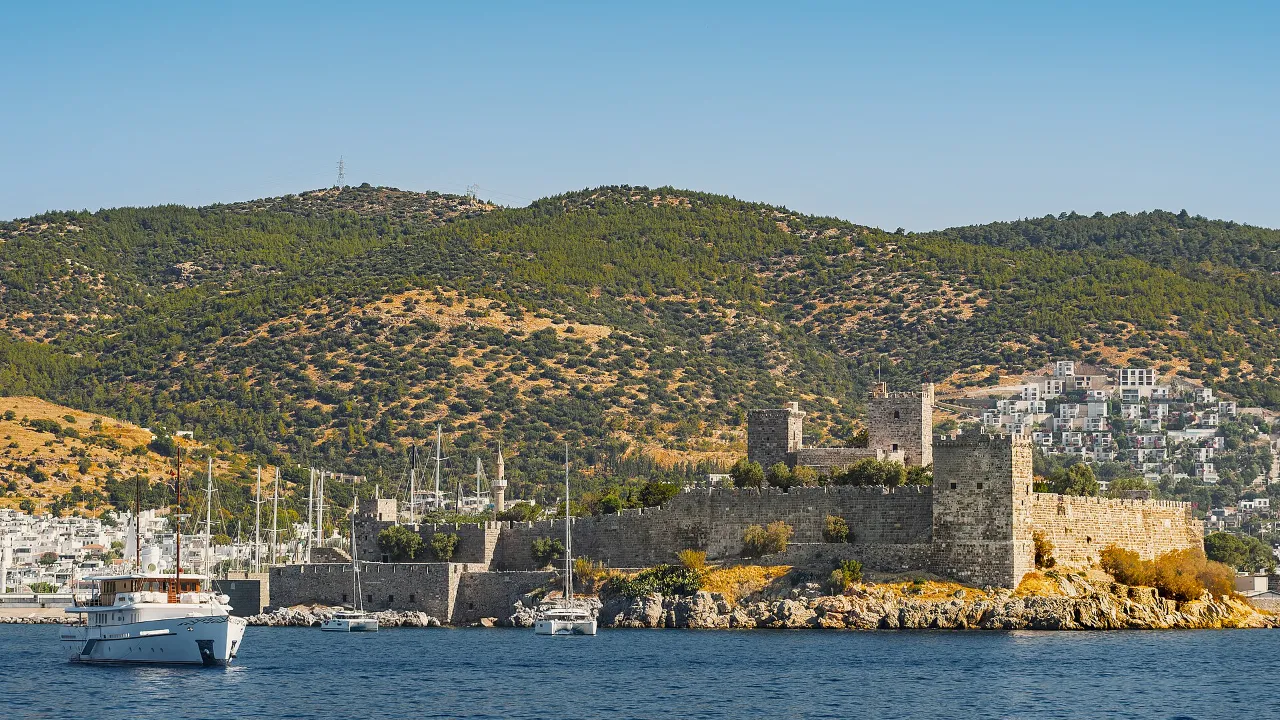
The town stands on the site of ancient Halicarnassus, home of the Mausoleum, one of the Seven Wonders of the Ancient World, of which only ruins remain. The Castle of St Peter, built by the Knights Hospitaller in the 15th century partly with stone from the Mausoleum, dominates the harbour and houses the Museum of Underwater Archaeology. Restoration work has continued for several years, so only parts of the castle may be open at a time.
Modern Bodrum grew from a sponge-diving and fishing town into a resort from the 1970s onwards. It is now known for marinas, beach clubs, restaurants and nightlife, but also for low white houses and bougainvillea, with mostly low-rise building across the peninsula. Recent news, such as a large plot reportedly bought near Kaplankaya on the wider Milas–Bodrum coast, keeps the area in the spotlight among wealthy buyers.
Getting there and getting around
Milas-Bodrum Airport lies about 36 kilometres north-east of Bodrum town, in neighbouring Milas district. According to State Airports Authority (DHMİ) data reported by airport operator TAV, it handled about 3.92 million passengers between January and September 2026, up 5% on a year earlier. Domestic traffic rose by about 10% to 2.33 million, while international traffic slipped by about 1% to 1.58 million. June alone brought almost 579,000 passengers.
These figures show two things. First, domestic links, especially to Istanbul and Ankara, are strong and run all year. Second, most direct flights to the UK and the rest of Europe operate between spring and autumn. In winter, residents often fly via Istanbul or use İzmir Adnan Menderes Airport, which has more year-round routes but is a drive of a few hours away.
On the peninsula, dolmuş minibuses run from Bodrum’s bus station to the main bays, and ferries and day boats link the town with nearby Greek islands such as Kos in season. In practice, most residents outside the town centre rely on a car. The single main road around the peninsula becomes congested in high summer, and travel times between bays can double. Check our guide to tolls and motorways if you plan to drive longer distances.
Climate
Bodrum has a hot Mediterranean climate. Based on 1991–2020 averages, daytime highs reach about 35°C in July and August, with nights around 24°C. January highs are about 15–16°C and lows around 8–9°C, so frosts are rare. Annual rainfall is about 700 mm, most of it between November and March. Strong summer winds make the peninsula popular with sailors and windsurfers, especially on the western and northern bays.
Many homes were designed for summer use. Before buying, ask how a property is heated in winter, whether it suffers from damp, and how it copes with heavy rain.
Water and infrastructure
Water is a real issue in Bodrum and worth asking about. The peninsula relies mainly on the Mumcular and Geyik dams, which together hold about 60 million cubic metres. In September 2025, after a dry year and heavy summer demand, the Muğla water and sewerage authority (MUSKİ) announced rotating, scheduled water cuts. Tankers were also widely used in summer. In May 2026, after a wet winter, local reports said both reservoirs were close to full and an academic at Muğla Sıtkı Koçman University said no drinking-water shortage was expected that year. He also warned that pipeline leaks and water quality remained problems.
For buyers, this means asking whether a property has a mains connection, a storage tank and a pump, and how often it relied on tankers in recent summers. Sewerage connections also vary by area: MUSKİ has been extending networks in the region, including in neighbouring Milas.
Neighbourhoods compared
Bodrum centre (Kumbahçe, Tepecik, Eskiçeşme, Gümbet). The town itself suits people who want to live year-round within walking distance of shops, the marina, public offices and the castle. Kumbahçe and Tepecik have older stone houses and flats on narrow streets near the harbour. Eskiçeşme and Gümbet, to the west, are busier resort areas with hotels and holiday flats. Prices for sea-view homes near the castle are high.
Konacık. On the hills above the town, Konacık is where many local families live all year. It has schools, supermarkets and newer apartment blocks, and is usually cheaper than the coast. It is a practical choice for working residents.
Bitez and Ortakent/Yahşi. These south-facing bays west of the town are popular with families and long-term residents. Bitez has a sheltered bay with mandarin groves behind it. Ortakent and Yahşi share a long beach. In the May 2026 summer-home survey, Bitez had the highest average price per square metre in the country, at about 161,600 lira, and Yahşi was close behind at about 159,900 lira. Valuation firm EVA put typical asking prices in Bitez–Ortakent at about 18–30 million lira.
Turgutreis. The peninsula’s second-largest town, on the west coast, has a marina, a large weekly market and a good range of services. It offers more modern flats and complexes at lower prices than the north-coast bays. EVA’s 2026 range for homes there was about 9–18 million lira, which makes it one of the few parts of Bodrum where homes near the $200,000 residence-permit threshold can be found.
Gümüşlük. A protected fishing village with waterside restaurants and the remains of ancient Myndos. Building rules are strict, supply is limited and the atmosphere is relaxed. EVA’s 2026 price range was about 12–25 million lira.
Yalıkavak. Once a sponge-diving village, Yalıkavak is now known for its superyacht marina, designer shops and upmarket villas. The May 2026 survey put the average at about 160,800 lira per square metre and the average home at about 27.8 million lira. EVA put villas at about 25–80 million lira.
Gündoğan. A quieter bay on the north coast, popular with Turkish families and second-home owners. The survey put average prices at about 152,800 lira per square metre.
Göltürkbükü (Türkbükü). The peninsula’s most exclusive bay, known for beach clubs, boutique hotels and luxury villas. EVA put villa prices in Türkbükü at about 35–245 million lira. Many homes here are let at very high rates in peak season.
Torba. Close to the town and the airport road, Torba has hotels, villa complexes and sea-view hillside homes. It appeals to buyers who want to be near both the town and the airport.
What property costs in 2026
Bodrum is the top end of the Turkish resort market. The May 2026 summer-home survey placed four Bodrum neighbourhoods at the top of the national ranking, all above 150,000 lira per square metre. Valuation firms quote even higher figures for prime properties: TSKB Gayrimenkul Değerleme estimated Bodrum’s average summer-home price at about 265,000 lira per square metre in its 2026 study. It said price growth had slowed to about 20% over the previous year, after a jump of 67% in 2023–24.
For context, Muğla had the highest average asking price of any province in July 2026, at 87,244 lira per square metre, according to Emlakjet and Endeksa. That is about double the national average. At mid-October exchange rates of about 49 lira to the dollar, 150,000 lira per square metre is roughly $3,000. Nationally, the central bank’s house price index rose 23% in the year to August 2026, but fell in real terms, as our report on house prices in August explains.
Prices vary widely within the district. Inland villages and Konacık flats cost far less than the north-coast bays, and older homes without an occupancy certificate trade at a discount for good reasons. For a broader comparison, read our guide to where to buy property in Turkey, and the city guides for Fethiye, Antalya, Alanya and Istanbul.
You can browse current property for sale in Bodrum on Vartur, or listings across Turkey.
Renting in Bodrum
Renting for a season before buying is sensible, but it is not cheap. According to Emlakjet, average asking rents for flats in Bodrum were about 570 lira per square metre a month in September 2026, up 24.7% over 12 months. That is around 57,000 lira a month for a 100-square-metre flat. Rents near the town centre and in Kumköy, Eskiçeşme, Gümbet and Kumbahçe were higher, while inland villages were much cheaper. Muğla as a whole had the second-highest average rent of any province in August 2026, at about 40,940 lira.
Long-term lets are hardest to find from May onwards, when many owners switch to holiday rentals that can earn far more. The TSKB study put a typical weekly summer rent for a two-bedroom villa at about 80,000 lira, while luxury villas in Göltürkbükü were advertised at several million lira a month. Look for a 12-month contract signed in autumn or winter. Rent increases on lease renewals are capped by law; see our report on the October 2026 rent cap. Our cost of living guide covers other everyday costs.
Checks before you buy in Bodrum
High prices make mistakes expensive. Work with an independent lawyer and check the following.
- Title deed and land status. Confirm ownership, liens and the land’s zoning with the land registry (TKGM). Some plots are in protected areas or on agricultural land, where building rights are very limited.
- Building permit and occupancy certificate (iskan). Bodrum Municipality reported demolishing 53 illegal structures in the first half of 2026 under the Zoning Law, including extensions at a site in Akyarlar. Check that every part of the property, including pools, annexes and extra floors, matches the approved project. A zoning amnesty certificate is not the same as an iskan; see our zoning amnesty explainer.
- Valuation report. A licensed valuation report is required for sales to foreign buyers, and it is used for citizenship applications.
- Residence permit value. For a property-based residence permit, a home bought since October 2023 must have a deed value of at least $200,000, and the neighbourhood must be open to foreign residence registration. Most closed neighbourhoods were reported to have reopened in 2026, but confirm the status of the address with the Muğla migration directorate. Read our residence permit guide.
- Citizenship. Citizenship by investment requires property worth at least $400,000, kept for three years. Many Bodrum villas exceed this, but the rules are detailed; see our citizenship by investment guide.
- Site management and running costs. Villa complexes charge maintenance fees for security, gardens and pools. Ask for the last year’s accounts and any planned extra charges.
- Agent and payment. Use an agent with an authorised listing, and pay through a bank. Note the secure payment system for property sales and the new listing rules for foreign owners.
Our step-by-step guide to buying as a foreigner and guide to purchase costs and taxes explain the full process. This guide is general information only. Check with a lawyer and the relevant official office about your own case.
If you plan to let your property
Holiday letting is a major reason people buy in Bodrum, but the season is short. Our report on Bodrum and the Aegean autumn season shows how quickly demand drops after summer. Under the short-term rental law, renting to tourists requires a permit from the Ministry of Culture and Tourism, and in buildings with several units all owners must agree. Unlicensed letting can bring heavy fines; see our short-term rental explainer. Booking platforms are also being brought under new licensing rules. Lawyers also warn that letting out a home can affect a property-based residence permit. Budget for management, cleaning, pool care, insurance and tax, and ask for real booking records rather than projections.
Healthcare and schools
Bodrum has a state hospital and several private hospitals. Acıbadem Bodrum Hospital, in the Müskebi area near Ortakent, opened in 2012 and has about 108 beds, including intensive care, and works with Turkish social security as well as private and foreign insurers. Memorial Health Group opened a 148-bed hospital in Ortakent in 2025. Plans for a larger new state hospital in Konacık have been discussed for years. For very complex treatment, patients may be referred to İzmir or Istanbul. Residence permit applicants need health insurance; see our explainer on health insurance for foreign residents.
State schools teach in Turkish. Private schools are more common in Bodrum than in many resort towns. Bodrum Private Marmara College is authorised by the International Baccalaureate to offer the Diploma Programme and the Primary Years Programme in English. TED Bodrum College in Ortakent offers language programmes from kindergarten to high school. Fees are high and places can be limited, so apply early. The education ministry has moved to ease school registration for foreign children.
Settling in
Once you move, the same national steps apply as anywhere in Türkiye: a tax number, a bank account, a residence permit through e-İkamet, address registration, an e-Devlet account and IMEI registration for a phone bought abroad. Our moving to Turkey checklist puts them in order, and our guide to renewing a residence permit covers timing and fees.
Daily life follows the seasons. From June to September, the peninsula is crowded, restaurants are fully booked and roads are slow. From November to March, many beach clubs and hotels close, especially in Türkbükü, Gündoğan and Yalıkavak, while the town centre, Konacık, Turgutreis and Bitez stay active. Weekly markets, sailing clubs and community groups help newcomers meet people. Prices in marina restaurants are closer to Western Europe than to the rest of Türkiye.
Pros and cons at a glance
Reasons people choose Bodrum
- A cosmopolitan atmosphere, with marinas, restaurants and cultural events.
- Strong domestic flight links to Istanbul and Ankara all year.
- Very varied bays, from busy resort towns to quiet villages.
- Low-rise building in much of the peninsula.
- Good private healthcare and more private schooling than most resorts.
Points to weigh up
- The highest property prices of any Turkish resort, and high running costs.
- Seasonal international flights.
- Water shortages in dry years and congested roads in summer.
- Unlicensed building, which makes permit checks essential.
- Rental income concentrated in a short summer season, and only with a permit.
Bottom line
Bodrum suits buyers with a larger budget who want a lively, international Aegean lifestyle, marinas and good private services, and it remains the benchmark for luxury resort property in Türkiye. Those on a tighter budget, or who need a home near the $200,000 residence-permit threshold, will find more choice in Turgutreis, Konacık or other coastal towns. Visit in both winter and summer, ask hard questions about water, permits and running costs, and rent before you buy if you can.
Frequently asked questions
Which airport serves Bodrum?
Milas-Bodrum Airport, about 36 kilometres north-east of the town. It handled about 3.9 million passengers in January–September 2026; domestic flights run all year, while most international routes are seasonal.
How much does property cost in Bodrum in 2026?
A May 2026 survey put Bitez, Yalıkavak, Yahşi and Gündoğan above 150,000 lira per square metre, the highest summer-home prices in Türkiye. Turgutreis and Konacık are considerably cheaper.
Which part of Bodrum is best for year-round living?
The town centre, Konacık, Turgutreis and Bitez stay active in winter and have shops, schools and services. Türkbükü, Gündoğan and Yalıkavak are much quieter outside summer.
Can I get a residence permit by buying in Bodrum?
Yes, if the home’s deed value is at least $200,000 for a purchase since October 2023 and the neighbourhood is open to foreign residence registration. Health insurance and other documents are also required.
Are there international schools in Bodrum?
Bodrum Private Marmara College is authorised to teach the International Baccalaureate Diploma and Primary Years programmes in English, and other private colleges offer language-focused programmes. Fees are high and places limited.
Does Bodrum have water shortages?
In dry years, yes: rotating water cuts were introduced in autumn 2025. After a wet winter, the main reservoirs were reported close to full in May 2026, but buyers should still ask about storage tanks and supply history.
Last updated: 17 October 2026. Rules, fees and thresholds in Türkiye change often; check the latest official guidance or ask a licensed lawyer before you act.
Sources
- Short-term residence permit required documents (Presidency of Migration Management, e-ikamet)
- Bodrum Private Marmara College programmes (International Baccalaureate)
- TAV airports September 2026 passenger traffic, DHMİ data (Foreks)
- Milas-Bodrum Airport June 2026 passengers, DHMİ data via AA (Türkgün)
- Muğla district populations, end-2025 TÜİK data (Haber Gazetesi)
- Yazlık fiyatlarında Bodrum rekor kırdı, May 2026 summer-home survey (Yeni Asır)
- Yazlık evlerde 2026 tarifesi, TSKB Gayrimenkul Değerleme study (Bigpara/Hürriyet)
- Yazlık fiyatları bütçeyi zorluyor, EVA Gayrimenkul Değerleme (Bigpara/Hürriyet)
- Bodrum rental flat market, September 2026 (Emlakjet)
- Emlakjet-Endeksa August 2026 rent report (Foreks)
- Most expensive provinces per square metre, July 2026, Emlakjet/Endeksa (Ulusal)
- TCMB house price index, August 2026 (Karar)
- Bodrum'da kaçak yapıyla mücadele: 2026'da 53 yapı yıkıldı, AA (24 Saat)
- MUSKİ planned rotating water cuts in Bodrum, September 2025 (Yeni Birlik)
- Bodrum reservoirs full, no shortage expected in 2026, May 2026 (DHA)
- Acıbadem Bodrum Hospital (Acıbadem)
- Memorial opens 148-bed hospital in Bodrum (Milliyet)
- TED Bodrum College (TED Bodrum)
- Residence permit property threshold raised to $200,000 (Cumhuriyet)
- Citizenship property threshold raised to $400,000 (Bloomberg HT)
- Valuation report mandatory in sales to foreigners, TKGM circular (Bloomberg HT)
- Türkiye reportedly removes neighborhood restrictions for foreign residents (Türkiye Today)
- Bodrum: history, castle and 1991–2020 climate data (Wikipedia)
- USD/TRY rate, 14 October 2026 (Hisse.net)
Photo: Mustang Joe / CC0, via Wikimedia Commons